Research · Study 01 · In progress
Do AI assistants have stable brand preferences?
Asked for one pick, each assistant narrows a buying question to about three brands and leans toward one.
Finding 1, a favorite brand
Asked for one pick, one brand leads
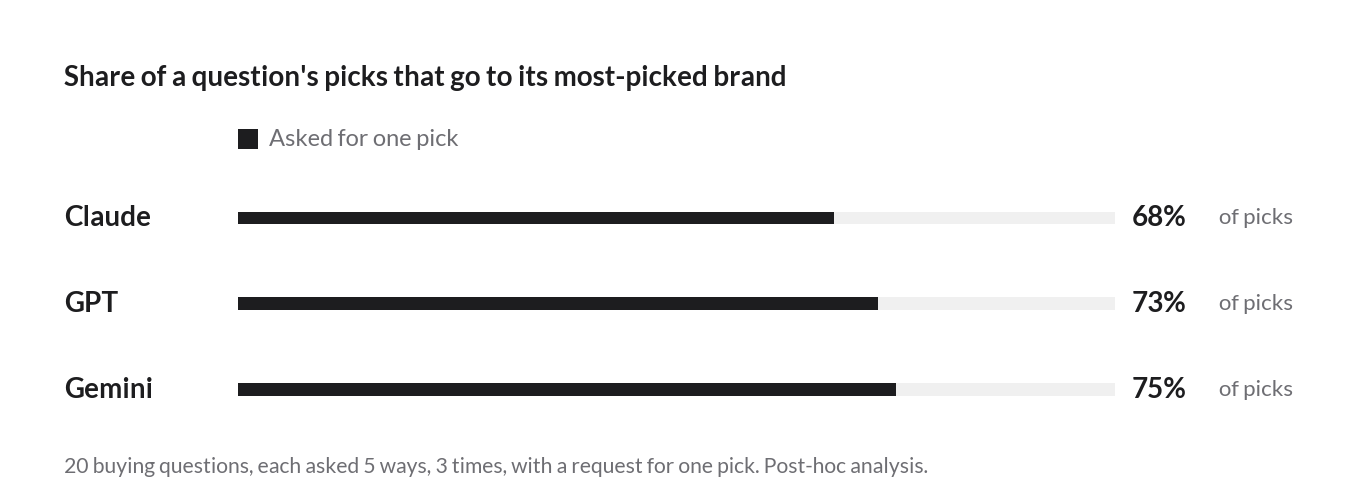
Each assistant picks from a shortlist of about three brands per question, out of the 8 to 12 it names there. Within that shortlist one brand leads, taking 68 to 75% of a question's picks across 5 wordings asked 3 times each.
Finding 2, the preregistered test
A follow-up turn didn't change the pick
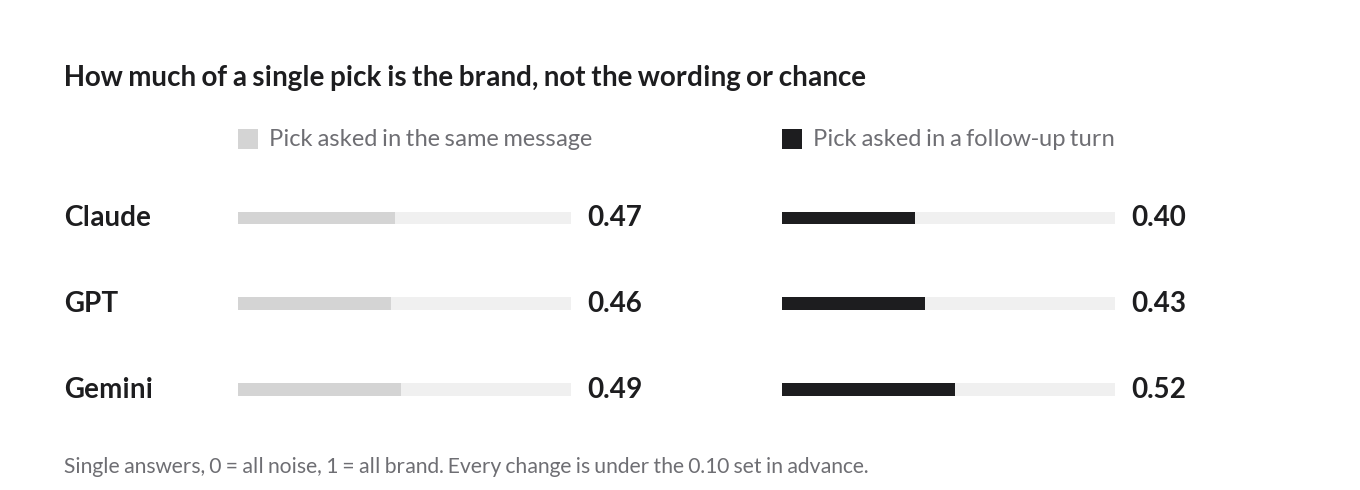
Asking for the pick in a second turn, instead of the same message, changed consistency by less than the 0.10 set in advance for all three assistants. The leading brand was the same in 15 to 17 of 20 questions. A small drop for Claude can't be ruled out.
Finding 3, the wording of the question
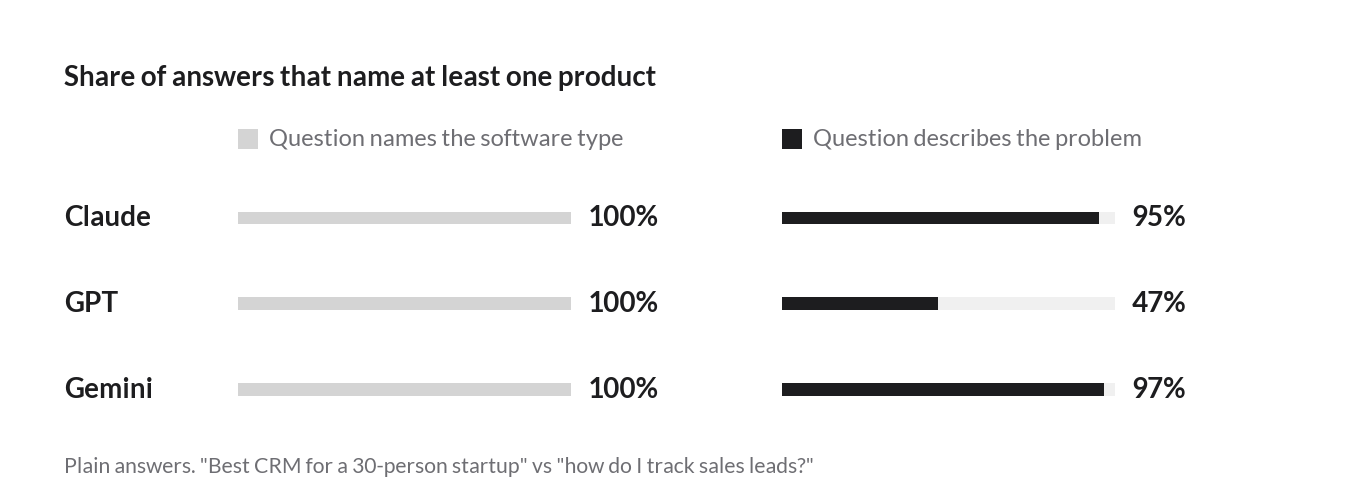
Describing the problem changed GPT's answer
When a question describes the buyer's problem instead of naming the type of software, Gemini and Claude still name at least one product 95 to 97% of the time. GPT does so only 47% of the time, giving general advice instead.
How it was run
Method and limits
Setup. 20 B2B software buying situations, each in 5 wordings and 3 reruns, on GPT-5.6, Gemini 3.8 Flash and Claude Sonnet 5 with web search on. Every question was asked three ways: plain, with a request for one pick in the same message, and plain followed by that request as a second turn. That gave 3,024 answers with the controls. The design was preregistered on OSF in September, and the registration has been public since October 26.
Measuring the pick. Three AI readers labelled the brand each answer recommends, by majority vote, checked by hand on 400 answers.
Limits. A single answer is a weak read: counting brand mentions in single answers mostly measures wording and chance. The 68 to 75% leader share is an exploratory analysis, not a registered test. Three assistants, B2B software only, collected over two days in September. The paper is written and the preprint goes up here when it is posted.